
|

Web www.basilwhite.com |
STUDENTS: Read this handout and bring your questions about it to first day of class. Relax: most of it's fun.
Students: This is a working workshop of work: we start writing and editing jokes as soon as possible. You don't have to know anything before class, but once you get to class, you'll be glad you did the little bit of class preparation.
The more you're ready to use concept-mapping and Statement/Assumption/Reality/Connector before class, the more time you'll have to write and edit your jokes and work on stagecraft. A WinWord reference card of everything you need before class is at http://www.basilwhite.com/indexSoMpatterns.rtf. If you like, it will fit nicely on two sides of a 4x6 index card. Send questions to
 or post them at http://www.facebook.com/basilwhitedotcom. Thanks! --Basil White
Applying Humor to Other Writing Forms - http://www.basilwhite.com/comedyworkshop/default.htm
Or, Bolting a Reverse Gear Onto Your B******t Detector
Abstract: If you can read this, and you can laugh, you can write humor! Learn to apply the basic psychology of how your brain gets a joke to discover what's "gettable" about your subject matter, real or fictional, for humor writing or other ironic purpose. This class also works as a fun introduction to the fundamentals of workshopping, for those new to the expectations of creative workshops. BEFORE CLASS, read basilwhite.com/comedyworkshop and bring questions to class. Learn how to tighten comedy material and verbalize comedy ideas. Choose words that evoke sensory experience, and find the funny point of view in serious situations and topics. Class preparation at basilwhite.com/comedyworkshop. If we have time, we'll get to advanced style topics like word economy, breaking assumptions with prepositional phrases, embedding the imperative tense and imperative sensory verbs.
How the Class Works
This class is about reverse-engineering your ability to laugh into an ability to create a joke. We turn your ability to explain what's funny about other people's jokes into an ability to write jokes, by tricking your brain into explaining what's funny about a joke that doesn't exist yet.Then we show you how to play this trick all the time so you become a ceaseless audience member of the comedy show called reality, and you view every experience as a punchline for a setup you haven't written yet.
Really. We do this. Every session. If you can laugh, you can write a joke that at least will be funny to you.
Science doesn't know a lot about how comedians write jokes. However, we know a lot more than we used to know about how and why people laugh.
We know people assign expectations to an experience why they're still having the experience. We know that when people become aware of how they assigned the wrong expectation to an experience, the brain gives us a pleasure response that makes us laugh.
We know that laughter conditions us to think about how we chose the wrong expectation, rehearse the experience, share it, seek out more violated expectations in the future, build smarter expectations, survive longer and have more babies. Laughter is the short-term reward for noticing when we get it wrong. The long-term reward is street smarts and grandchildren.
Here's one way to look at how to reverse-engineer your ability to laugh into an ability to create a joke.
Audience Member: topic -> expectation -> unexpected -> logical connection to unexpected -> laughter. You hear a statement about a topic that seems to make sense but actually serves to make the nonsensical statement you hear next make sense. Topic, setup, punchline.
Comedian: topic -> unexpected -> logical connection to unexpected -> expectation -> joke. The comedian chooses a topic and imagines something nonsensical about it, then creates a statement that seems to make sense about the topic but instead rationalizes the nonsensical statement. Topic, punchline, setup.
You can reverse-engineer your ability to laugh into an ability to create a joke by choosing a topic, creating a statement about that topic that bears no logical connection to it, building a logical connection from the unexpected to the topic, and generating an inference that seems to support the expectation but logically connects the unexpected to the topic.
Choose a topic. Write a nonsensical statement about your topic, then write a statement that seems to make sense about your topic but actually makes the nonsensical statement make sense. Topic, punchline, setup. Then switch these statements so the punchline comes last.
Schedule
The Science of Getting a Joke - Being Funny Is Not A Science, But How And Why People Find Something To Be Funny Is Remarkably Scientific. Let's Exploit That.
The Pleasure Center Of The Brain Has A Problem-Solving Region. This Is Why You Laugh At Your False Assumptions, Make Better Assumptions And Stay Alive, a.k.a. Cavemen Don't Get It
Concept-Mapping: Use the words humor research subjects use to explain why they laugh (Weird Stupid Hard Scary) as questions that generate funny answers
Let's Concept-Map Something Together
Go away and build your own Concept-Map
Everyone builds your Concept-Map together (note to self: bring lots of index cards!)
Comedy Buddy each other's concept-maps
Preview of Sleight-of-Mouth Patterns a.k.a prove the illogic of other people's stupid opinions
Homework: Go away and build a legible narrative from your Concept-Maps
Challenges and advantages of writing narrative based on a Concept-Map
Stage blocking to edit dialogue aka pivot your body in a unique direction for each voice in your head
Sleight-of-Mouth Patterns: Find assumptions in your narrative and destroy them
Statement/Assumption/Reality/Connector - choose a statement you don't believe, determine the assumption that must be true for the statement to be true, write a statement of reality that refutes the assumption, and write a connector that connects rationally from the statement to the reality that refutes its assumption.
Use Statement/Assumption/Reality/Connector for characters and plots
E-prime: Replace the verb "to be" with a sensory verb
Embedding the imperative case: Sneaking commands into your text to hypnotize your audience to imagine the sensory experiences of the events in your story, a.k.a. let me know if you'd like to FEEL SOMETHING NOW
The Scott Adams Comedy Adjectives: Cruel, Cute, Clever, Naughty, Familiar and Bizarre
Introduction
For both beginning and experienced fiction and/or creative nonfiction writers. This workshop will focus on individual awareness of a person's own ability to get jokes and how to adapt that ability to other forms, including humor and non-humor writing, fiction, non-fiction, screenwriting and poetry. The workshop will discuss the learning exchanged among the fields of standup comedy, comedy writing, neuroscience, neurolinguistic programming and stagecraft.
Participants will choose a topic and learn how to apply comprehension of their sense of humor to:
- Reveal the irony of a topic
- Reveal the topic's assumptions
- Ask questions about the assumptions that yield irony and humor
- Use comedy syntax for maximum effect
- Reframe the act of writing as creating messages of sensory experience
- Minimize the words necessary to convey sensory experience
- Embed sensory commands into Applying Humor to Other Writing Formswriting
Participants will also discuss how the methods listed above apply to other writing forms. Participants are invited to bring their own writing goals to class to apply these comedy tools to their current projects, adding the dimension of humor and humor writing tools to their repertoire. The instructor strongly recommends that students who want to get a head start on the course should read the handout in advance at http://www.basilwhite.com/comedyworkshop/default.htm and study the Joke Prospector section of the textbook, Greg Dean's "Step-By-Step to Applying Humor to Other Writing Forms Comedy." This textbook is available at the Writer's Center. This workshop begins promptly on time! Show up ready to work!
Instructor: Basil White performed live comedy for 11 years. His jokes are in several mass-market joke booksApplying Humor to Other Writing Forms. He moonlights as a technology writer and editor, and has published articles and online courses on technical writing, usability and information architecture. He has an M.A. in Science Writing from Johns Hopkins University. His website is www.basilwhite.com.
The Problem
Comedy performers use strategies for writing and editing material for jokes. These strategies apply to other writing forms, but comedians have no stake in sharing these strategies with each other or with writers outside the craft.
Who Does The Problem Affect?
Those who would benefit from applying their ability to sense humor into an ability to write humor.
Why Should You Care?
These strategies apply to writing outside of comedy, e.g., word economy, evoking sensory experience, revealing irony, and revealing discrepancies between assumptions and outcomes. All sentences are referential and contain some presupposition. A presupposition is something that must be true for the statement to make sense, that still must be true even if the statement is refuted or disbelieved. For example, "X is Y." You may believe that X is not Y, but X must exist, at least conceptually, for you to accept or refute that X is Y. Exploit these presuppositions.
What is Humor?
Here's my definition.
Humor is a perceived experience of an unexpected deviance from a pattern that causes laughter, especially a pattern that suggests a threat to the perceiver or perceived that is deviated by a non-threatening resolution.
What is a Deviance From a Pattern?
Pattern deviators deviate from social norms, expectations of what belongs together in a set, expectations of the meaning or significance of words and phrases, or expectations of a result.
What Patterns Cause Laughter?
A pattern that causes laughter includes a deviation from the pattern that the audience experiences before they have an opportunity to invent a deviation themselves from the pattern prior to the deviation. Comedians talk about the rule of three, because a set of three elements is the smallest set that can suggest a pattern and deviate from it.
Tools of Applying Humor to Other Writing FormsComedy Writing
Judy Carter's Four Comedy Adjectives (from Judy Carter's "Comedy Bible")
- Weird
- Stupid
- Hard
- Scary
These adjectives have value to comedy syntax because they reflect the adjectives audiences use to answer the question "Why did you laugh at that?" Comedy is an art form, so there aren't hard rules of how to choose or combine words, but there are scientific discoveries of the experience of laughing at a joke that writers can exploit to get people to laugh at another joke. Weird/Stupid/Hard/Scary is one of these discoveries. Another example is putting the punchline word at the end of the sentence so that the audience can laugh without being distracted by having anything more to read or hear.
Concept Mapping (from Judy Carter's "Comedy Bible") - Finding The Irony In The World
A concept map defines a concept by indicating what other concepts are connected to it, using connectors that may or may not have their own labels. For my class, we take any concept you want and define it with connectors labeled weird, stupid, hard and scary and concepts phrased as declarative statements that answer what is weird, stupid hard or scary about the concept that points to that statement. Other uses of concept maps connect concepts by interrogative words (who/what/how/when/where/why), causal relationships (caused/is caused by), or by free association with no labels for the connectors.
Beans ----weird/stupid/hard/scary---> declarative statement about what's weird, stupid, hard and/or scary about beans.
The magic's in the recursive nature of the map. After you define what's weird/stupid/hard/scary about what's weird/stupid/hard/scary about what's weird/stupid/hard/scary about beans, you get into declarations that are specific, focused and funny.
I work hard all day to support my family. Why shouldn't I force my kids to fart under the guise of enforcing healthy nutrition?
Concept mapping software is available on the web. Just search for "concept mapping software" or use this link: http://www.altavista.com/web/results?itag=wrx&pg=aq&aqmode=s&aqa=software&aqp=concept+mapping&aqo=&aqn=&aqb=&kgs=1&kls=0&dt=tmperiod&d2=0&dfr%5Bd%5D=1&dfr%5Bm%5D=1&dfr%5By%5D=1980&dto%5Bd%5D=20&dto%5Bm%5D=9&dto%5By%5D=2004&filetype=&rc=dmn&swd=&lh=&nbq=10M
Concept-Mapping (above) is like Judo; you're just deflecting the meaning of reality into humor.
Sleight-of-Mouth is like kung fu: you have to create your own reality and meaning, like getting an entire traffic jam moving again.
Concept Map for Comedy Writing
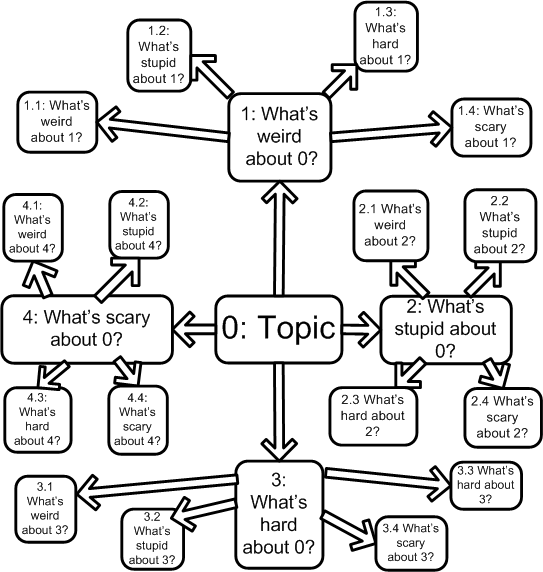
A 4x6 index card of a blank mind map is at http://www.basilwhite.com/indexmindmap.doc.
Questions? Send them to
or post them (anonymously if you want) on my FAQ at http://basilwhite.livejournal.com/174976.html?mode=reply.
To build a concept map, start with the central topic ("Topic Zero"). What's weird about this topic? What's stupid about it? What's hard about it? What's scary about it? Answer these questions using the verb "to be" (is, was, were, are, etc.) Answering the concept-map questions with "to be" verb phrases reveals assumptions, which we then violate. We call this comedy. An assumption is a setup that doesn't have a punchline yet.
Add your answers to the four questions as subtopics with their own bubbles and arrows. Ask these questions again of the subtopics until you get to the irony. Often the irony comes from reframing weird, stupid, hard and scary features of a topic as having unexpected positive outcomes. In other words, things are weird, stupid, hard and scary, but what's weird, stupid, hard and scary about these weird, stupid, hard and scary things is that in a different context (such as the contexts you generate in Sleight-of-Mouth patterns) they can be sensible, smart, simple and reassuring.
An Example
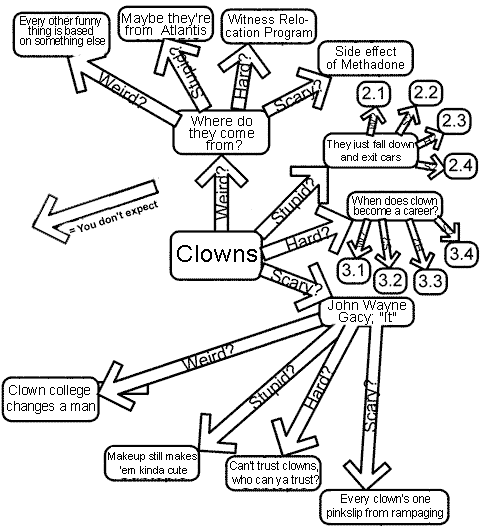
Other connectors for the concept map are:
- Who
- What
- How
- Where
- When
- Why
- So What
- Assumes (x assumes y)
- Caused by
- Causes
- Opinion
- Free association (insert your own conscious or semi-conscious connector here)
Another way to extend your concept map when you're done answering these questions is to explain how the underlying assumption for it is false. For example, if your root is "It's good to know moral people" and you have a "Why" connector to "They'll stand up for you in a crisis", a "Falsifier" link for the "They'll stand up for you in a crisis" node might be "But moral people won't kill your enemies in their sleep."
Text Version
X can be about whatever you like, but I recommend you keep it to a noun or noun phrase, because we're creating adjectives here and adjectives modify nouns. Not my rule.
1. What's weird about X?
2. What's stupid about X?
3. What's hard about X?
4. What's scary about X?
5. What's weird about what you wrote in question 1?
6. What's stupid about what you wrote in question 1?
7. What's hard about what you wrote in question 1?
8. What's scary about what you wrote in question 1?
9. What's weird about what you wrote in question 2?
10. What's stupid about what you wrote in question 2?
11. What's hard about what you wrote in question 2?
12. What's scary about what you wrote in question 2?
13. What's weird about what you wrote in question 3?
14. What's stupid about what you wrote in question 3?
15. What's hard about what you wrote in question 3?
16. What's scary about what you wrote in question 3?
17. What's weird about what you wrote in question 4?
18. What's stupid about what you wrote in question 4?
19. What's hard about what you wrote in question 4?
20. What's scary about what you wrote in question 4?
Continue this to one more level. I've found that the comedy comes from the third abstraction, e.g., what's weird about what's stupid about what's stupid about X. Another trick is to take your completed concept-map and replace the topic of the source of a link to another topic that also connects logically to the same target, e.g., A -> B becomes X -> B, so that "Garbage -> get it out of the house" becomes "23-year-old unemployed son -> get it out of the house."
Exercise - Create a topic for your own Concept Map! Map it as much as you can! For now, just stick to the connectors of Weird, Stupid, Hard and Scary. Write it on something you can loan to me at the end of the exercise. Writing your concept Map on this handout would be bad.
Questions? Send them to
or post them (anonymously if you want) on my FAQ at http://basilwhite.livejournal.com/174976.html?mode=reply.
Workshopping Students' Concept Maps
Look what we made!
Brainstorming - Positive outcomes? Potential applications for you?
Another application of Concept Maps (extra credit)
Comedy Buddy (from Judy Carter's "Comedy Bible"), adapted for single-session workshopping
Writer 1 lists goals & problems they want to discuss. Writer 2 sticks to taking notes and asking who/what/how/where/when/why questions about Writer 1's goals and problems without giving advice. KEEP CREATION AND EDITING SEPARATE! If Writer 2 has any advice, Writer 2 writes the advice on notes. Writer 2 takes the last few minutes to review the notes they wrote, and gives the notes to Writer 1. Then switch roles.
The Comedy Buddy method can make you a better workshopper in any context. You can listen to someone talk about their story, limit your responses to connectors (weird/stupid/hard/scary, who/what/how/when/where/why, or just why), add your own connectors to their concept-map as you think of them, and give them something they can use. Having the Comedy Buddy method ensures you that you have something to bring to the table.
Why this works - a highbrow explanation
Socrates in Euthyphro reveals the choice between the pain of changing one's opinion versus the pain of remaining wrong. Some humor walks people through this process gently like Socrates, by taking an assumption as fact for the sake of argument and finding contradictory examples and trying to redefine the statement to accommodate them.
Socrates' technique of questioning reveals this emotional dilemma by showing the ignorant certitude of Euthyphro, and Socrates shows how difficult it is to persuade those who don't notice or don't care, that one of their strongly-held beliefs has just been demolished. But it's a lot of fun!
The trick is to criticize what you revere. "Only those who are willing to criticize what they revere can ever achieve any knowledge of piety in its most profound sense, but those most willing to criticize tend to be unserious: profoundly, as well as superficially, irreverent."
There's comedy gold in making fun of ignorant certitude, and questioning the idea that what one reveres is what one ought to revere. There's a lot of fervent believing out there, because humans are willing to believe that what they believe should be believed because it's right or ordained. Maybe it's right or ordained because we give belief to it.
Your job as comedy philosopher is to expose those who would rather remain wrong than change their opinion. But be fair: holding illogical, false, contradictory opinions is human nature and not a sign of intellectual deficiency, and can be portrayed either by you or by the subjects you're ridiculing for humorous effect. <-- a lot of this is hacked and adapted from Mark A. R. Kleiman, www.markarkleiman.com.
A Socratic questioner should:
a) keep the discussion focused
b) keep the discussion intellectually responsible
c) stimulate the discussion with probing who/what/how/where/when/why questions
d) periodically summarize what has and what has not been dealt with and/or resolved
e) draw as many students as possible into the discussion.
Socratic method for Comedy Buddy - Used in the context of teaching binary math to 3rd graders - http://www.garlikov.com/Soc_Meth.html - notice the exclusive use of the interrogative words (who, what, how, when, where, why). Turns unproductive discomfort into productive discomfort.
A 4x6 index card of finding assumptions in text is at http://www.basilwhite.com/indexjokeedit.doc.
Exercise - Concept Mapping Each Other's Topics Using the Comedy Buddy Method
Classroom activity - pick someone you don't know to be your Comedy Buddy. Workshop your topic with them for five minutes, using the Concept Map and the Joke Prospector. Then switch roles.
Look what we made!
Brainstorming - Positive outcomes? Potential applications for you?
Statement/Assumption/Reality/Connector - Generating Irony by Proving What You Don't Believe
Concept Mapping is like Judo; you're just deflecting the meaning of reality into humor.
Statement/Assumption/Reality/Connector is like kung fu: you have to create your own reality and meaning, like getting an entire traffic jam moving again.
STATEMENT/ASSUMPTION/REALITY/CONNECTOR, THE CONDENSED VERSION:
State one of your strong beliefs. Choose a statement you don't believe, determine the assumption that must be true for the statement to be true, write a statement of reality that refutes the assumption, and write a connector that connects rationally from the statement to the reality that refutes its assumption. Optional: Act out an example of this punchline. Optional: Tag the punchline with another example.Why does this work?
State one of your strong beliefs. Choose a statement that is contrary to this belief. "Going to the contrary" provides a contrary perspective on a problem, and turns your belief (a story about you) into a story with greater ramifications and scope. It's a lot easier to make fun of a believe you don't share than a belief you hold dear.What beliefs do you have to sell at your job? What are some contradictory beliefs? What assumptions must be true for those contradictory beliefs to be true? What reality refutes those assumptions? There's your advertising campaign.
Homework: Go away and build a legible narrative from your Concept-Maps
Capture what you like from your concept map into some narrative form: an essay, poem, scene from a novel, short story or play, etc. Fit it on one piece of paper. Make copies for everyone.
Day Two
Exercise - Workshopping Each Other's Joke Maps Using the Comedy Buddy Method
Joke Prospector - The Joke Mine
The Easy Version (aka "Mr. Opposite"
- Belief: State a belief you hold.
- Opposite: State a literal opposite to the belief you hold.
- Proof: State a proof for the opposite statement, using sensory verbs.
- Punch: Refute the proof in a way that refutes the opposite belief and supports your belief.
Example:
- Belief: I believe the children are our future.
- Opposite: I believe the children are not our future.
- Proof: Children can't read; how can they maintain a legacy of our civilization?
- Punch: By growing up and forcing their children to read.
I find refuting an opposite belief much easier, useful and more fun than supporting a belief.
Joke Mine - Getting to the Irony
- 2.A. ASSUMPTIONS: Select a setup (1.E., above.) What am I assuming about this statement? What must be true for your setup to be true? <-- These are your ASSUMPTIONS.
- 2.B. CONNECTORS: What isthe thing that caused me to make this assumption (2.A), expressed as a Who/What/When/Where/Why/How question? <-- These are your CONNECTORS.
- 2.C. REINTERPRETATIONS: Other than the assumption (2.A), what other interpretations are there for my connector (2.B)? <-- These are your REINTERPRETATIONS.
- 2.D. 2ND STORY: Relative to the setup (1.E), what specific situation could explain my reinterpretation (2.C)? <-- This is your 2ND STORY.
- 2.E. PUNCH: In addition to the setup (1.E.), what information is needed to communicate my 2nd story (2.D) clearly? <-- This is your PUNCH.
- 2.F.
TAGLINE(S):
(My addition) What reinterpretation of the setup (1.E.) is needed to communicate both the 2nd Story (2.D) and the punch (2.E.) clearly? (Actually, Dean suggests this step, but doesn't add it to his formal outline.)
Joke Prospector Example
1. Joke Map
- 1.A. TOPIC(S): Noun that I consider wrong (conflict, issue, problems, resentment, blame, self-righteousness) that I'm interested in talking about: Clowns
- 1.B. SMALLER ASPECTS: What are the smaller aspects (nouns and noun phrases), FREE FROM OPINION, that relate to my topic that are short and specific? clown origins, clown behavior, clowning as career, abuse of clown trust by psychopaths
- 1.C. NEGATIVE OPINIONS:What negative opinions do I have about these smaller aspects (without including an example)? unknown clown origins make them suspect, clown behavior is inscrutable, clowning as career suggests personal dysfunction, abuse of clown trust by psychopaths suggests need to regulate and restrict clown supplies or a waiting period as per guns for background checks and to let people make sure they really want to clown (Hey! I'm already getting to the funny!)
- 1.D. POSITIVE OPINIONS:What's the contrary, positive opinion to each negative opinion? unknown clown origins make them trustworthy, clown behavior is rational, clowning as career suggests a centered, focused career path, abuse of clown trust by psychopaths suggests need by psychopaths to be loved and to attend clown class as therapy
- 1.E.
SETUPS:
What are some specific examples or statements that express my larger, contrary opinion? ("1.E", because 1.D). Clowns are magical because the origins of clowning are a mystery to me, I identify with 20 inappropriately-dressed people climbing out of a car, if I hadn't made so many bad career decisions I could have a respectable job like a clown, clowning is just a cry for help by people who want to be loved and trusted -- like John Wayne Gacy and Stephen King's 'It'
<-- These are your SETUPS.
2. Joke Mine
- 2.A. ASSUMPTIONS: Select a setup (1.E., above.) What am I assuming about this statement? What must be true for your setup to be true? People clown in order to be loved and trusted <-- These are your ASSUMPTIONS.
- 2.B. CONNECTORS: What isthe thing that caused me to make this assumption (2.A), expressed as a Who/What/When/Where/Why/How question? How are clowns trusted? When are clowns trusted? <-- These are your CONNECTORS.
- 2.C. REINTERPRETATIONS: Other than the assumption (2.A), what other interpretations are there for my connector (2.B)? Clowns are trusted by parents to keep children's attention, not as individuals or in other contexts <-- These are your REINTERPRETATIONS.
- 2.D. 2ND STORY: Relative to the setup (1.E), what specific situation could explain my reinterpretation (2.C)? Parents hire clowns to entertain at birthday parties, not as babysitters. If you had a clown show up uninvited at your home and ask if you need any clowning, you'd call the cops <-- This is your 2ND STORY.
- 2.E. PUNCH: In addition to the setup (1.E.), what information is needed to communicate my 2nd story (2.D) clearly? If my babysitter showed up in a clown costume, I'd have them arrested. Clowns don't go from house to house singing circus music. <-- This is your PUNCH.
- 2.F.
TAGLINE(S):
(My addition) What reinterpretation of the setup (1.E.) is needed to communicate both the 2nd Story (2.D) and the punch (2.E.) clearly? (Actually, Dean suggests this step, but doesn't add it to his formal outline.) You hire a clown for your kid's birthday party, you keep your eye on 'em. You keep your eyes on the clown. The last thing you want is a random clowning.
A Shorter Way to Reverse Assumptions
- 1. CHALLENGES: Consider the challenges or issues facing the problem-solver.
- 2. ASSUMPTIONS: List the assumptions inherent in the problem.
- 3. REVERSES: Write literal reverse assumptions for each assumption.
- 4.
RELEVANCES:
Make the reversals relevant to the problem.
There are other problem-solving concepts you can take from business courses in critical thinking and problem-solving to get at root causes of problems, like asking "Why?" about the problem, then "Why?" about your answer, recursively five times, and SCAMPER (Substitute, Combine, Adapt, Magnify/Modify, Put to other uses, Eliminate, Rearrange/Reverse).
Exercise - Building a Joke Mine for Your Own Topics
Explore your topic through the Joke Mine as far as you can before the end of the break. Write it on something you can loan to me at the end of the break. Writing your Joke Mine on your handout would be bad.
Workshopping Students' Joke Mines
Look what we made!
Brainstorming - Positive outcomes? Potential applications for you?
Applying the Four Comedy Adjectives to the Plot Cycle
One of my writing teachers taught me the idea of the "Plot Cycle" where experience leads to a "moment of discovery" that leads to a "moment of decision" that leads to action that leads to another experience etc. Sometimes I write essays like this where I write:
- The experience
- What's weird about the experience
- What's stupid about the experience
- What's hard about the experience
- What's scary about the experience
- The moment of discovery
- What's weird about the moment of discovery
- What's stupid about the moment of discovery
- What's hard about the moment of discovery
- What's scary about the moment of discovery
- The moment of decision
- What's weird about the moment of decision
- What's stupid about the moment of decision
- What's hard about the moment of decision
- What's scary about the moment of decision
- The action
- What's weird about the action
- What's stupid about the action
- What's hard about the action
- What's scary about the action
- IF STORY ≠ CONCLUSION GO TO 1
- END
This exercise gets the story out and forces me to write in the context of "so what."
Another application of Concept Maps - Connecting to a Thesis (extra credit)
Another connector for concept maps is the connector of a thesis. If you already have a thesis (aka Summary Philosophical Statement) for what you haven't written yet, you can write the thesis in the center of your concept map and write who, what, how, where, when and why nodes out of it and on the lines, write how each node supports the thesis.
Exercise - Workshopping Each Other's Joke Mines Using the Comedy Buddy Method
Look what we made!
Brainstorming - Positive outcomes? Potential applications for you?
Humor In Characterization
This is where 12-step recovery programs are helpful. Character defects can provide insight as to deviations from:
- constructive behavior
- morality
- truth
- courage
- responsibility
- rationality
- maturity
- positive attitudes
- self-esteem
- respect for others
- recognizing actions that don't work
- desire and attempts to be competent
- following explicit rules
- respecting property and authority figures
- accepting the reality of a situation
What are the individual character defects or character defects of humanity that you'd like to address in your writing? How can you embody these character defects in the characters in your writing?
Or, what character defects do your characters have? Why do they have them? What is the message you want to give your audience by giving that defect to your character?
How can you create irony by creating a character that should have a specific character asset based on their background (police should pay attention to their surroundings) but instead has the opposite character defect (a police officer who is too introspective to pay attention)?
How can you create irony by creating a character that should have a specific character defect based on their background (serial killers should have no respect for others) but instead has the opposite character asset (a serial killer who volunteers at a thrift store)?
If your story has a character who acts in a way that has negative outcomes, you can create a chain of causes and effects (AKA "comedy of errors") with awareness of new problem, action, coping skill, outcome, side effect that causes new problem, ad nauseam. There's a principle in cognitive-behavioral therapy that people do what they do because they believe that it will get them the outcomes they want. Therefore, people act on coping skills that have negative outcomes, which they mitigate with other coping skills that have other negative outcomes ad absurdum.
Humor of Treating Your Character's Problem as an Analogy of a Global Problem
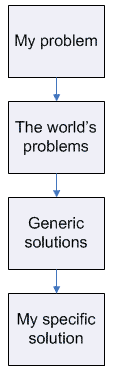
Find one of the world's problems that is an analogy to your character's problem and apply the world's generic solution to your character's smaller problem. An example would be a character viewing his debt problem as "operating in a deficit" or dealing with the neighbor's loud dog by hiring an arbitrator.
http://www.basilwhite.com/comedyworkshop Clear Comedy (HEAVILY paraphrased and adapted for comedy from (http://www.ai.uga.edu/mc/index.html) -
Clear comedy means KEEP IT SIMPLE, STUPID. Inspired, wise comedy uses the clearest, simplest language necessary to put the experience in the listener's head.
Clear Comedy Is Essential to Success
Clear words lead to clear thinking. You don't know what you know until you put words to it. If you can't explain it, you don't know it.
The Cold-Reading Test
Writing came from people wanting to record what people said, so have other people read your writing cold to make sure it's conversational.
Clear Comedy Helps You Seem Like Less of an Ass
Writing clear comedy reflects on your character, because clear comedy says "I'm doing what's easy for the audience, not what's easy for me. I'm not saying these words because I'm important, I'm saying these words because the people listening to me are important." One way to be unselfish when you speak is to package your thoughts so they enter people's heads as easily as possible. Comedy requires effort because listening to comedy requires effort. Comedy is almost too complicated for human beings to do. The least we can do as comics is take on as much of the load as we can.
Write Like You Talk. Talk Like You Think.
One way to use clear words is use the process of thinking in your joke. Something provokes you to think, so you compose words to explain your thought. Then you play with the words and test your thinking by talking it out. You test your thought out on the world to see if the world supports your thoughts. Thinking and talking both use these steps.
You can find several jokes that have exactly these steps, in order, one sentence at a time, e.g., Experience provokes new thought provokes a statement about the thought provokes wordplay or testing the thought with logic or experimenting on the world.
Word Choice
Using a word you don't understand is a hack move. NEVER use a word unless you know EXACTLY what the word means. If you're not sure, look it up.
The Dictionary Is Your Friend
Look up a word in the dictionary. The words in the definition of that word are OFTEN better choices than the word you started with. The dictionary people are much better than we are at defining a concept with a single sentence of easy words. That's their job.
Look at your joke. Ask yourself "Is there anything that can be misunderstood?" This is the test that the dictionary people use when they verify the definition of a word. The best dictionary for comedy is a high school student's dictionary, something geared for young adult readers.
Language is the act of defining a thought; that's how language works. Exploit the wisdom of the dictionary people. Of course, a lot of jokes mislead people deliberately, but make sure that can be misunderstood is the one thing you WANT them to misunderstand. You get one misdirection per laugh; use it wisely.
Simple Sentences a.k.a. Word Economy
"One of the best things you can do for yourself to improve your comedy is to learn how to cut out words that are not necessary."
becomes --> "One of the best ways to improve your comedy is to learn how to cut out words that are not necessary."
becomes --> "To improve your comedy, learn how to cut out words that are not necessary."
becomes --> "To improve your comedy, learn how to cut out unnecessary words."
becomes --> "To improve your comedy, cut out unnecessary words."
The next step is a comedy style move of using the imperative (the sentence style of direct orders, like "Tote that barge!") to delete words and command the listener to do something. Switching to imperative also helps you turn a long sentence into two short ones, and encourage the listener to imagine a sensory experience because your command to experience something sneaks "under the radar" of strategies people use to notice someone's commanding them to do or assume something. A related sales term for this is th "assumptive close" -- read http://psychology.wikia.com/index.php?title=Assumptive_close.
"Improve your comedy. Cut unnecessary words."
There! 25 words reduced to 6!
From http://www.basilwhite.com/comedyworkshop
Where's The Meaning Coming From?
What's the one word in the sentence that if you deleted it takes out more meaning than any other word? circle it. What are the words that directly modify or are directly modified by that word? Circle them. Read just the circled words as a sentence. Now add only the words that you absolutely have to add to complete the meaning and sound conversational.
"One of the best things you can do for yourself to improve your comedy is to learn how to cut out words that are not necessary."I think the word CUT is the one that takes out more meaning than any other word. CUT is modified by the word YOU and modifies WORDS.
You cut words.
The MEANING missing from this is why you cut words (improve your comedy) and what kind of words to cut (unnecessary). Now we look at the words that directly modify or are directly modified by "You cut words."
Improve your comedy you cut unnecessary words.
We can cut this again by shifting to imperative case (the comedian's friend) and splitting this into two sentences that sound conversational.
Improve your comedy. Cut unnecessary words.
Avoid Stepping On Your Punchline
Don't use the word in your punchline until you get to the punchline. You want your punchline word to be a surprise, and using it in advance tips off the audience. That's all I have to say about that.
Combining the skills of replacing confusing words, using the imperative, word economy, and saving your punchline words for the punchline, the sentence
"You, sir, embody all degradations of vice, which I curse as I curse the despicable, harmful circumstances created by your malevolent existence."
becomes --> "F**k you."
See? It's magic!
The Comedy Lodge
If you have trouble silencing the voices of criticism and procrastination, you may want to start or join a Comedy Lodge. The Comedy Lodge is based on the "immersion music method" of songwriting explained in the book The Frustrated Songwriter's Handbook and adapted here for comedy. The Comedy Lodge is a group of people writing humor independently all day long and gathering at the end of the day in an event free of consequences and expectations.
Bring snacks.
The goal is to create comedy, but also to teach each other to break individual inhibitions and procrastination. You can't get hurt, nothing counts, and you're just messing around. You're just being persistent about messing around, because you have until you wake up in the morning until the beginning of the lodge meeting to come up with twenty (20) original jokes. There's pressure, but it's pretend play game pressure. You can't be too critical to write, because the demands of the game require you to work too fast to judge.
Preparing for the Lodge Meeting
Designate a date, a time (in the evening), and a place where everyone will show up, on time, with snacks. Snacks are important. Commit to the lodge meeting and do nothing that day but prepare for it. From the moment you wake up until you leave for the lodge meeting, YOU WILL WRITE TWENTY (20) ORIGINAL JOKES FROM SCRATCH. The goal isn't to write something funny, the goal is to write something DEVELOPABLE. You're not writing jokes, you're writing "lodge jokes." Write dumb jokes and trainwreck punchlines on purpose. Focus on making your lodge buddies laugh at the lodge meeting.
At the lodge meeting, all feedback is positive and in the context of developing the joke, rewarding each other's bravery for opening up and taking a chance, what you like about the joke, and how to move the joke forward. THIS IS NOT TO BE NICE. This is to keep the focus on developability.
Write with no fear of the listener, because the "listener" is the lodge members who focus on the positive and how to move it forward.
Fun lodge joke starter exercises:
- Write a line, then write a line beneath it, then write a line about lines 1 and 2, then "forget" line 1 and write a line about lines 2 and 3, etc.
- Write jokes about the nouns in an existing joke that don't serve as the main topic or punch word of the original joke.
- Take the ending line of one of your jokes as the first line of a new joke.
- Write down the last thing you'd ever want to admit on a comedy stage. Write a joke about it. Edit out the incriminating evidence later. LATER.
- Picture a funny visual scene and describe it.
- Pick a topic you'd like to write a joke about and just start writing words, phrases and sentences with that topic.
- Say what you're thinking, what you normally wouldn't say out loud, the exact, unfiltered, unedited truth.
- Take two existing jokes at random (hereto named "A" & "B"). Write a segue that connects A to B. Use the segue as the first line of an original joke. Then switch the two existing jokes and write a segue from B to A and write a joke for this second segue.
- Talk to yourself on paper. Write down some topics you think are weird, stupid, hard or scary. For each topic, write down "(topic) is weird/stupid/hard/scary because (explanation)." Write the question "What's weird, stupid, hard or scary about (explanation)?" Write down "(explanation) is weird/stupid/hard/scary because (another explanation)." Keep chaining these explanations.
-
Running the Lodge Meeting
Go to the lodge meeting. BRING SNACKS. The lodge meeting has a pre-arranged beginning and wrap-up time. Once you're at the lodge meeting, you take turns. Make room at the end of the circle for latecomers. Latecomers take their turn at the end of the circle and lose their first turn. Go in order by who showed up first. The first member (let's call her Alice) performs ONE JOKE. The other members write ideas as the joke is being performed on ways to take the joke forward. Then another member (let's call him Bob) reads one of their ideas from their notes. This is when everyone starts talking. Everyone riffs off Bob's first idea and Alice writes down everyone's riffs as fast as possible until everyone's done riffing off of Bob's first idea. Then Bob reads his second idea and everyone riffs again and Alice takes notes until Bob's out of ideas and it's Ted's turn to read his ideas about Alice's joke one at a time so the lodge can riff on each idea. Then everyone gives their notes to Alice. Index cards are useful for this.
Then it's Bob's turn to perform ONE JOKE. Loop around the members until you reach the wrap-up time, then keep going until everyone gets an equal amount of performances (except the latecomers who lose a turn). Then everyone picks the best joke each person did and they are honor-bound to perform some version of that joke the next time they're on stage.
The snacks are important. You'll be starving by the time the lodge meeting starts.
Stuff to take home
Third-Party Reading
Another way to exploit others for your art is to get someone else to read your writing aloud. Where they flub the line is where you need to edit. Stop them where they flub and ask them how they'd rephrase it in their words.
E-Prime - Writing Without the Verb "To Be"
E-Prime is English without the verb "to be." Deleting all forms of the verb "to be" limits descriptions to sensory and subjective experience, which helps bring out the assumptions embedded in declarative statements of fact. The verb "to be" isn't bad or wrong, it's just a cue that there's an assumption or belief lying nearby to be mined for comedy gold.
-
Good article about E-Prime - http://en.wikipedia.org/wiki/Special:Search?search=e-prime&go=Go
-
Online E-Prime inspector - http://www.manifestation.com/neurotoys/eprime.pl
<-- easy way to look really smart.
Embedding the imperative case: Sneaking commands into your text to hypnotize your audience to imagine the sensory experiences of the events in your story, a.k.a. let me know if you'd like to FEEL SOMETHING NOW
Take your sentence, determine the imperative case, and add other words around the imperative case to change the sentence into the case you need. For example, "She bought a newspaper" becomes "Buy a newspaper" becomes "She stopped to buy a newspaper." The imperative case invokes sensory experience of the imagined event.The Scott Adams Comedy Adjectives: Cruel, Cute, Clever, Naughty, Familiar and Bizarre
Explained at http://dilbertblog.typepad.com/the_dilbert_blog/2005/12/humor_formula.html. Basically, I try to use these to edit material to make sure every sentence is cruel, cute, clever, naughty, familiar or bizarre, and I use them to guide the emotion I have as I speak each sentence.Adapting Applying Humor to Other Writing FormsComedy Tools to Humor Prose, Non-Humor Prose, and Fiction
- Greg Dean's Narrator vs. Self vs. Character dialogue - rewriting in 3rd person with no omniscience, then as the character receiving the the story's action, then as the character performing the action
- Assumptions of statements - What assumptions am I (the author) making? What assumptions are the characters making? What assumptions will the reader make? How are the assumptions wrong?
- Interrogative conjunction questions that are answered by the assumptions - who/what/how/when/where/why questions that the assumptions generated by the story would answer
- 2nd stories that answer the interrogative conjunction questions that conflict with the assumptions - What's another answer for the who/what/how/when/where/why questions that contradict the assumptions generated by the story
- Sensory (see/hear/feel) descriptions - changing the nouns, verbs and adjectives of the story into words with more concrete sensory associations
- Stealthy use of the imperative case - "Sneaking" commands to the reader to see/hear/smell/taste/touch the sensory experiences of the story and its characters
Adapting Comedy Tools to Poetry
- Sensory (see/hear/feel) descriptions - changing the nouns, verbs and adjectives of the story into words with more concrete sensory associations
- Stealthy use of the imperative case - "Sneaking" commands to the reader to see/hear/smell/taste/touch the sensory experiences of the story and its characters
Audio Recording
Recording yourself reciting your draft from memory helps to rewrite the draft into words that reflect the genuine syntax and sensory experiences of the passage. You can also work from notes that list the sensory experiences only and "invent" the passage by describing those experiences extemporaneously. This adds the sincerity of you reporting your own participation in the experience you're trying to create (from Greg Dean, "Step by Step to Applying Humor to Other Writing Forms Comedy".)
If done in character, recording allows you to portray the character and include stylistic features about how the character is saying what they're saying (grunts, coughs, speed, timbre) and discover where these features need to be added to the text to convey the experience.
I adapted this technique from "Sanford Meisner on Acting": Read your manuscript in as unmeaningful and relaxed as you can, so you'll be open to any influence that comes to you. Then record yourself improvising the script without reading the notes. Then merge the differences between the recording and the script.
The Neuroscience of Comedy - Why This Sensory Stuff Works
New research in neuroscience indicates that even though different kinds of humor stimulate different parts of the brain, there is a part of the brain associated with survival and problem-solving that is always stimulated when we find something to be funny. This suggests that humor is the brain's way of rewarding people for noticing a false assumption.
This cocaine-like humor response encourages people to look for more false assumptions, think about the experience, and share it with the tribe so everyone learns from the experience. Lots of survival benefits to this.
The theory is that to survive, humans have to constantly make assumptions about what to pay attention to, what's important, why it's important, and what's going to happen next. Socially, they're competing with each other for the best ability to predict what's going to happen next or how to make something happen. Humor is a neurochemical way for the brain to force significance onto recognizing a false assumption.
When a person reacts to a joke the electrical activity in the brain is like the activity when an event is unexpected and a new meaning must be found. The brain gives a pleasure response for finding this new meaning: in fact, when people recognize a message as a joke, the faster the recognition the funnier they rate the joke. In this way, humor appreciation mirrors the pleasure of creativity.
The Concept Map is also a valid model of how the mind builds, reinforces and discards assumptions.
Using Neurolinguistic Programming to Create Sensory Experiences Through Writing
Crash course on NLP at http://www.covertcommunications.com/nlp/crashcourse.html.
Using past tense reports past experience. Using present tense (e.g., "I'm (verb)ing", "(3rd party) says to me," etc.) reenacts the experience in the here and now. Using the present tense to report past events can be a challenge but is easier for the reader to accept if it's used in quoted dialogue from a character ("So Sarah says to me, she says, 'Gimme that!'")
Imperative tense, aka "commands," with sensory verbs (see, hear, feel) commands the reader to have a sensory experience, e.g., "See the newspaper? What a story!" "Ask a guy on the street, he'll tell you." "Rest the chuff of your hand on my hip." (Walt Whitman)
According to NLP, emotions are associated with sensory channels of experience (see/hear/feel/taste/smell) and can be embedded in the minds of others with sensory commands. Using the imperative tense and words with strong sensory associations encourages people to "reenact" these sensory experiences in their minds. See yourself filling your notebook with imperative sentences and sensory words. Hear the satisfying scratch of the pen on crisp paper. Turn another completed page. Smell the victory. Taste the champagne at your release party.
Visual words: appear, blank, bright, brilliant, bring it into focus, clarify, clear, color, dark, enlightening, envision, examine, eye, flash, focus, foggy, foresee, frame, gaze, get the picture, glimpse, glitter, hazy, horizon, illuminating, illusion, illustrate, image, imagination, insight, insightful, light, look, looks good, murky, notice, observe, outlook, paint, perspective, photographic, picture, preview, reflect, reveal, scan, scene, see, see, shine, show, sparkling, survey, view, vision, visualize, vivid, watch
Auditory words: Accent, Amplify, Ask, Audible, Clear, Deaf, Dialog, Discuss, Echo, Frequency, Harmonize, Hear, Listen, Listen, Loud, Loud and clear, Melody, Monotone, Musical, Noise, Proclaim, Question, Quiet, Remark, Resonate, Rhythm, Rhythm, Ring, Ring, Rings a bell, Say, Saying, Scream, Screech, Shout, Shrill, Sound, Sound, Speak, Speechless, Strike a chord, Symphony, Talk, Tell, Tempo, Told, Tone, Volume, Yell
Kinesthetic words: bond, cemented, cold, come, concrete, contact, excited, feel, flowing, gentle, grasp, grip, handle, have a feel for, heavy, hit, hold, loaded, moving, pressure, push, rough, rub, scrape, sensitive, shook, smooth, softened, solid, standpoint, sticky, stress, stroke, stuck, suffer, tackle, tangible, tense, tension, tight, touch, toughened, unloaded, warm, worm
NLP Questions that break assumptions:
- According to who/what?
- In what way is/are (noun) (adjective)?
- In what way is/are (verb) (adverb)?
- Can you think of an exception to (absolutes; e.g., never/always)?
- Can you think of an exception to (cause/effect pair)?
- How do you know what you say is true?
- Is (noun) the same as (name-calling/label)?
- How do you know (assertion that would require mind-reading)?
- By whose/what authority (must/should/have to) (verb)?
- What, specifically?
- Who, specifically?
- Why, specifically?
- Which, specifically?
- How, specifically?
- Can you think of an exception?
Manipulate and Destroy Beliefs for Fun and Profit
The Quick Version - Statement/Belief/Contradiction/Connector
- Write a STATEMENT that you don't agree with that you'd like to write a joke about. Sentences that use the verb "to be" (is, was, were, are, etc.) are prime sources for statements with which you can disagree.
- Write the underlying BELIEF that must be true for the statement to be true. This will be a belief that you don't hold.
- Write a logical COUNTERARGUMENT that reveals the illogic of the belief.
- Write a
CONNECTOR
that logically connects the STATEMENT
to your COUNTERARGUMENT. Put the word that reveals the logical connection as far to the end of the connector sentence as possible: this is your
PUNCH WORD.
The STATEMENT is your setup and the CONNECTOR is your punchline. Here's an example:
- STATEMENT: Thanks to the leadership of our party, America now has 10 million more jobs.
- BELIEF:More jobs means that more people are working.
- COUNTERARGUMENT:More jobs doesn't necessarily mean that more people are working; maybe they lost their one good job and have to work several part-time jobs for less net pay.
- CONNECTOR:Yeah, and I've got
THREE
of 'em.
The STATEMENT is your setup and the CONNECTOR is your punchline. THREE is your punch word because it reveals the logical connection between the statement and the connector. Here's your joke.
Thanks to the leadership of our party, America now has 10 million more jobs. Yeah, and I've got three of 'em.
Here's another way of approaching the same method. Pick a statement of fact (or a statement of fiction in the writing style of a statement of fact). Find the assumptions underlying that statement, and pick an assumption you like. Choose an alternate explanation for your statement of fact. Write a punchline that connects the natural statement to the alternate explanation.
Natural statement (aka setup): I wasn't sure my battery was going to last that long. Assumption: I was doing something that took a lot of time. Alternate explanation: What I do drains a lot of power. Punchline: I can kill a car battery in a commercial break. Soon I'll have to unplug the refrigerator.
Natural statement (aka setup): If man was meant to have sex with a keyboard, God would have given us three hands. Assumption: We need two hands to type and one hand to masturbate. Alternate explanation: The third hand is to hold up my credit card. Punchline: I can't masturbate and type and hold up my credit card. If I was that coordinated, I wouldn't need the Internet.
A WinWord reference card of the quick version of concept mapping and the Sleight of Mouth Method printable on 4x6 index cards is at http://www.basilwhite.com/indexSoMpatterns.rtf.
The Longer But More Adaptable Version: Sleight-Of-Mouth
(n.b.: Try these with advertising slogans.)
Redefine: What other meanings could this statement have? Use similar words with weirder, stupider, harder or scarier implications. What weirder, stupider, harder or scarier meaning could be assigned to the event? What other meaning could the statement or the elements in the statement have? "I take ecstasy...for the hugs." "The highway department put up a sign in front of our new house: 'Slow Children at Play.' I never played again." A. In other words, B.
Consequence: What will happen to them if they continue to think this way? What is a weird, stupid, hard or scary effect of the Belief or the relationship defined by the belief? Focus on a consequence that challenges the belief. Direct attention to the effect of the belief. Focus on a consequence that leads to challenging the belief. "I ruined the family's laundry. Now I don't get to do the laundry anymore. Imagine my sorrow." "Eat less, and you'll get twenty more years to be hungry." A. Which has the effect of B.
Intention: Why are they saying this? What are the positive benefits that come from this? What are they trying to gain? Directing attention to the purpose or intention of the belief. "I believe the children are our future, which allows me to have faith and shift blame at the same time." "Some day I'd love to teach, because my teachers were boring, but I think I can take a classroom to heights of boredom never seen before." "Churches don't pay taxes. Because we believe that they shouldn't. That's the power of faith." What's the weird, stupid, hard or scary reason why someone would state a belief? What is the secondary gain? What are they trying to get? What is the positive purpose or intention of this belief (belief, because goal)? A, because I want B. Bob: "I believe A." Carol: "I very much admire and support your desire for (Bob's real reason for declaring belief A). How's that working out for you?"
Chunk Down: Who or what, specifically? What are examples or parts of this? What smaller elements are implied by the belief but have a weirder, stupider, harder or scarier relationship than the ones stated in the belief? Look at a specific element that challenges the belief (belief, because smaller element of belief). Breaking the elements of the belief into small enough pieces that it changes the relationship defined by the belief. Look at a specific element that challenges the belief. "I don't know if there's an afterlife, but I am bringing a change of underwear." -- Woody Allen. "The great thing about nudism is you don't stand in front of a mirror worrying about what not to wear. 'Hmm... maybe nothing. No, I wore nothing yesterday.'" "This book is not for everyone, only for those who purchase and then choose to read the book." A. And B's a part of A.
Chunk up: For what purpose? What's important to them about this? Generalizing an element of the belief to a weirder, stupider, harder or scarier classification that changes the relationship defined by the belief. "I lost a button. Why go on living?" What's the purpose of the belief? What's important about the belief? Exaggerate. "I made a perfect omelet. Inform the media." What larger elements are implied by the belief but have a weirder, stupider, harder or scarier relationship than the ones stated in the belief? "By sharpening my pencils I add harmony to the universe." "I tie my shoes every day. 'Cos I'm a go-getter." Generalize in order to change the relationship defined by the belief (belief, because belief is a smaller element of larger element). A. And A's a part of B.
Counter-Example: What's the exception that disproves the rule? Find a weird, stupid, hard or scary example that does not fit the relationship defined by the belief. Find a weird, stupid, hard or scary exception that challenges the generalization defined by the belief. "Except When" jokes. "Democracy is the worst system of government, except for all the other ones." -- Churchill. Make into a universal statement or question. Was there ever a time when A causes "Not B"? What is an example or experience that is an exception to the rule defined by the belief? "Never follow good whiskey with water, unless you're out of good whiskey." "I believe the children are our future. Well, not the dead ones." Find an exception that challenges the generalization defined by the belief (belief, because generalization). A. However, B.
Another Outcome: What's another outcome you could shift to? Challenging the relevancy of the belief and switching to another issue altogether. Propose a different outcome that challenges the relevancy of the belief. "I'm up to my neck in alligators." The issue here is not about being worthless or not, but about how to get the chores done in the future." "The issue here is not about if you are bored or not, it is about how to improve your grades." "The issue is not about having friends or not, it is about being able to see clearly so you can succeed." What is another outcome you could shift to? "The issue isn't whether you have a head or not, the issue is whether or not you want breakfast!" "I broke a promise to myself. Turns out if a TV evangelist is on fire, I will pee on him." What other outcome or issue could be more relevant than the one stated or implied by the belief? Propose a different outcome that challenges the relevancy of the belief (belief, because unstated or nonimplied outcome or issue). A causes B, but A also causes C which is more interesting.
Analogy: What's a different or opposing metaphor? Finding a relationship analogous to that defined by the belief, but which has different implications. Use an analogy or metaphor that challenges the generalization defined by the belief. "When your dad forgot to take you to the ballgame last week like he promised to do, did that make him worthless?" "When you were learning to ride a bike, you thought practicing was fun and exciting?" "When your pet dog had to have eye surgery so he could see better, did your relationship with him change?" What story will relate to their belief? Tell a metaphor or story about the solution. What is some other relationship that's a metaphor for the belief but has different implications? Use an analogy or metaphor that challenges the generalization defined by the belief (belief, because analogy or metaphor of the belief). "Sending drug users to jail is like ordering a Diet Code with a pizza. It misses the real problem, but it makes us feel better." A->B is like C->D.
Apply to Self: Just use their words on their statement. Evaluating the belief statement itself according to the relationship or criteria defined by the belief. Use key aspects of the belief to challenge the belief. "That is a pretty worthless thing to say. It doesn't serve you well at all." "You have said that so many times. I would think you would be bored of that statement by this time." "That's not a very friendly thing for you to say." Don't think about it; just use the word back on itself. "So the head that you say you don't have thinks that you don't have a head?" "I quit high school and I turned out all right. I guess. I'm a dropout. How would I know?" How can you evaluate the belief statement itself according to the relationship or criteria defined by the belief? Use key aspects of the belief to challenge the belief (belief, because relationship or criteria defined by the belief). A->B. What an A (or B) thing to say.
Hierarchy of Criteria: What are their higher values? Apply their higher value to the statement. Re-evaluating the belief according to a criterion that is more important than any addressed by the belief. Re-assess the belief based on a more important criterion. "God thinks you are worthwhile, doesn't he?" "Don't you think it is more important to figure out a way to make better grades than it is to worry about something being boring and a waste of your time?" "Don't you think it is more important to see clearly, then how you look to him? What are higher criteria (values)? Apply current criterion (value) to current sentence. "Isn't it more important that you get along with me rather than worrying about some small defect like that?" What is a criterion that is potentially more important than those addressed by the belief that has not yet been considered? Reassess the belief based on a more important criterion (belief, because more important criterion). A ->B, but !A ->C which is more important.
Change Frame Size: What's something they haven't noticed about this? Reevaluating the implication of the belief in the context of a longer (or shorter) time frame, a larger number of people (or from an individual point of view), or a bigger or smaller perspective. "One of these days you will look back on this incident as a real important learning moment." "When you think about the bigger picture of school and learning in general, doing home work is only a small part of it." "There are probably more people in the world that wear glasses than those that don't." Something (larger or smaller) they haven't noticed. Different frame, same behavior. Chunk up to Universal Quantifier. "If we all used that excuse, nothing would ever get done." What is a longer/shorter time frame, greater/smaller number of people, or bigger/smaller perspective that would change the implications of the belief to be something more positive? Reevaluate the implication of the belief (belief, because different span of time, number of people, or perspective). A->B, but in a bigger/smaller scale of space time, so what?
Meta Frame: Challenge the basis for the belief. E.g. formulate a belief as to the origin of the belief. "A is (adjective)?" YOU'RE (adjective)!" Evaluating the belief from the frame of an ongoing, personally oriented context (establishing a belief ABOUT the belief). "You just feel that way because you think you have to do everything perfectly." "You feel that way because you think ALL of life should be exciting." "You feel that way because you want EVERYBODY to like you and want you as a friend." How is it possible they could believe that? "You only say that because you like to confuse people about how you feel." What other belief about this belief could change or enrich the perception of this belief? Challenge the basis for this belief, formulate a belief as to the origin of this belief (belief, because of belief that originated it). A->B 'cos you want it to be true.
Model of the World: Is this true in everyone's model of the world? Reevaluating the belief from the framework of a different model of the world. Look at the belief from a different perspective. "In our family, we don't let one incident ruin our self esteem." "Did you know that in China, a student has to copy Chinese characters for four hours every night. Aren't you glad you are not there?" "Most people don't think that wearing glasses has anything to do with friendship." Is this true in everyone's Model of the World? "In my opinion, you are saying that as a metaphor for something else, are you not?" What is a different model of the world that would provide a very different perspective on this belief? Look at the belief from a different perspective or model of the world (belief, because different model of the world). A->B, but only in your world.
Reality Strategy: How would they know if it's not true? Reevaluating the belief accounting for the fact that people operate from cognitive perceptions of the world to build beliefs. Re-assess the belief based on the fact that beliefs are based on specific perceptions. "How specifically do you know that you are worthless?" "What specifically makes it boring or a waste of your time?" "What specific thing did he say that made you think he did not want you for a friend?" How do they represent that belief? How do they/you know if it's not true? Apply current criterion (value) to current sentence. "How do you know that not having a head stops you from doing X,Y,Z?" What cognitive perceptions of the world are necessary to have built this belief? How would one need to perceive the world in order for this belief to be true? Re-assess the belief based on the fact that beliefs are based on specific perceptions (belief, because perception). A->B, 'cos my world seems to work that way.
http://www.brefigroup.co.uk/resources/meta_model.html - The Meta Model, developed by John Grinder and Richard Bandler, is a way to find the deletions, distortions and generalizations we create as we translate experiences into language.
Speechwriting and Comedy
Shared lead for speechwriting/comedy/public speaking:
- What the problem is (even if the problem is a goal that hasn't been achieved yet),
- who the problem affects, and
- why they should care.
Adapting Comedy Tools to Scriptwriting
- Greg Dean's Narrator vs. Self vs. Character dialogue - rewriting in 3rd person with no omniscience, then as the character receiving the the story's action, then as the character performing the action
- Stage blocking to critique dialogue - separate physical spaces for writing versus editing, reciting and recording versus listening and revising, etc.
- Sensory (see/hear/feel) descriptions - changing the nouns, verbs and adjectives of the story into words with more concrete sensory associations
- "Blocking" in dialogue - physically moving your body, either between two points or pivoting left to right to portray dialogue, can help you to improve your choice of words and make the word choices among the characters in a dialogue more distinct.
- "Soft" versus "hard" words - Would this character use phonetically gentle or rough words, e.g., Split or break? Filet or beef? Slay or kill? Characterization and recitation can drive word choice for characters - what words they'd use or avoid, slang, accents, etc.
Revealing Irony
Joke Map (Step 1 of Greg Dean's "Joke Prospector") yields statements that express opinions contrary to your actual opinion. Irony comes from using the Joke Mine (Step 2 of Greg Dean's "Joke Prospector") to make the contrary opinion ring true by adding a punchline. The formula is:
Example:True Opinion --> Contrary Opinion --> Punchline that makes the Contrary Opinion ring true.
Postal Service is inefficient --> Postal Service is efficient --> Postal Service is efficient with guns. (Greg Dean's example)
Revealing Assumptions
Two quotes from Greg Dean:
It's when our assumptions are wrong and we experience something that defies our assumptions that we're surprised. This is where irony, humor and jokes come from."Every part of a thing you imagine exists--but aren't directly perceiving--is an assumption."
"Any aspect of something you can't see, hear, feel, smell or taste exists only as an assumption."
Effective Questions That Yield Irony and Humor
- What are my assumptions?
- What caused me to make this assumption?
- What are the Who, what, how, when, where and why questions that are answered by the assumptions?
Using Comedy Syntax for Maximum Effect
- Put the punch word a.k.a. reveal (the word that reveals the broken assumption in your setup) at the end of the sentence, e.g., "with guns" in the Postal Service joke. The reveal is the word that reveals the true, assumption-shattering meaning of all the words prior to the reveal.
- Just because your line isn't funny doesn't mean it doesn't have a reveal; find the word in your sentence that removes the most meaning from the sentence and try to make it the last word in the sentence, e.g., "Shall I compare thee to a summer's ___?"
- Read aloud to find the rhythm in the sentences, even if you have to tap the syllables out with drumsticks. Move your body to the beat of what you read, hear and say. This connects your mind with the text.
The Act of Writing as an Hypnotic Act of Conveying Sensory Experience
- "Accidentally" use the imperative form where it doesn't belong ("See this movie, it's about a guy..."),
- Start with a visual or auditory verb (pref. visual), then use kinesthetic (feeling) verbs
- Ask an interrogative conjunction question
- Act out the response to the question
Word Economy: Minimizing the Words Necessary to Convey an Experience
What, at minimum, conveys the visual/auditory/kinesthetic components of the experience? Rewrite as "(Character/Reader)" sees x. (Character/Reader) hears x. (Character/Reader) feels x." Remember, you don't have to give the audience the exact experience that you have in your mind, just give enough content to convey some experience in the audience's mind. Trying to convey the exact experience that's in your mind can polish the joy off of the audience's experience. It's my opinion that people identify personally with art that reflects an intimate, personal experience of individual members of the audience, ironically by reflecting human experience in a universal way that only seems like an individual experience.
...Bring in specific personal elements, but don't (write) about "you"... Writing is an intense investigation into what it means to be a human being-- not what it means to be you. -- Judy Carter
Embed Sensory Commands Into Your Writing
Use pauses and breaks that hide the imperative form of a sensory command.
I daydream sometimes. Like, we're out, and--
Enjoy your free pizza.
we go for pizza and you pick up the check.
Gosh, I'm hungry. Maybe...
you're hungry for pizza right now?Applying Mihaly Csikszentmihalyi's "Flow" Process to Comedy
1. Make it a game. Comedy is a game. The rule is to be funny. The objective is to be funny to yourself and everyone else. The challenge is to make yourself and others laugh. The reward is work.
2. Powerful Goal - The overriding spiritual goal is to make people laugh at what you find to be funny. The social goal is to make people want to hear what you have to say. The intellectual goal is to find humor where it's never been found before.
3. Focus - Release your mind from all distractions, from within and without. Focus your entire attention on the game of being funny.
4. Surrender to the Process - Let go. Don't strive or strain to achieve your objective. Just enjoy the process of work.
5. Ecstasy - This is the natural result of the preceding four steps. It will hit you suddenly, by surprise. But there will be no mistaking it.
6. Peak Productivity - Your ecstatic state opens vast reservoirs of resourcefulness, creativity, and energy. Your productivity and quality of work shoot through the roof.
Four fallacies of Cognitive Therapy
(good mine for developing a character's "problem")
Fallacy of Catastrophic Failure: individual focuses on a disaster she or he imagines will happen, often making it happen by their own certainty.
Fallacy of Perfection: counterpart to the Fallacy of Catastrophic Failure; individual feels that he or she should be perfect. Perfection is an unrealistic goal in any human activity.
Fallacy of Approval: individual thinks that she or he must have 100% approval from everyone.
Fallacy of Overgeneralization: individual holds onto a previous experience or exaggerates it until he or she thinks it is the norm for behavior.
A 4x6 index card of the cognitive distortions is at http://www.basilwhite.com/indexcognitivedistortions.doc
What Editors Want
Memorable work that commands attention. Minimal verbs and adjectives. Maximum integrity. Speaks for itself instead of explaining what the response should be. Turns and surprises, mastery of a demanding task. Precise language, sufficient, persuasive data to support the thesis, advanced and defended through reasoned and reasonable argument, in a dramatic and paced narrative so the recipient stays with the narrative through the end. A narrative knows why it's being told, for whom, and what it wants to say. Respect competing arguments. Basic data, then interesting and provocative thesis.
Building A Character Defect For A Character
- Statement of character defect: I'm resentful and self-righteous.
- Statement of desire to do something that should be in my power: I want to recover from my resentment and self-righteousness.
- Contrary (Expressed in positive syntax): I want to retain my resentment and self-righteousness.
- Expression of character defect, using see/hear/smell/taste/feel verbs in the present tense: I blame other people for my bad experiences. I hold people up to impossible standards.
- Expression made funny, using same see/hear/smell/taste/feel verb of above expression(s): I shower blame like a lawn sprinkler. I hold people up to standards that NASA couldn't reach.
- Motivations and outcome that achieve an outcome using the character defect that the behavior above would seem to prevent: I'm just goin' with what works.
Perverting the OREP (Opinion, Reason, Example, Conclusion) Method
One method in extemporaneous speaking for expressing an opinion is the OREP (Opinion, Reason, Example, Conclusion) Method. Expert speakers call this the PREP (Point, Reason, Example, Point) Method, but my abbreviations don't have to be acronyms. You can use this method to generate humor by applying this method to a point that you don't believe. You state your opinion, state the reason why you have that opinion, you give an example to justify your reason for the opinion, then you make a conclusion from the example you gave, and maybe additional conclusions from there. Again, this is an irresponsible perversion of a public speaking technique that you should only use if you want to be funny. Any other use constitutes fraud.
Example:
Say I'm against a flag-burning amendment. Say it! So my opinion for this exercise is that I'm FOR a flag-burning amendment. A reason for this opinion is that I might equate burning a flag with hate speech. An example is that we limit some forms of speech for our own protection. The conclusion I might draw from that is that I should limit all forms of speech for my own protection.
I'm for an amendment banning flag-burning. Because flag-burning is a form of speech. Dumb people talk too much as it is. Put down the lighter and listen.
NLP questions for joke editing and adding depth to writing
- Nouns: nouns have as many meanings as there are people using that noun. ASK: what, specifically?
- Verbs: verbs can delete the specifics of the process. ASK: how, specifically?
- Gerunds: -ing verbs made into nouns can delete the process or action, creating a sense of 'stuckness'. ASK: who, how, what is ....ing? Turn the nominalization back into a verb.
- Pronouns: pronoun can be unspecified, deleting who or what it refers to. ASK: who, specifically?
- All, Every or Never: generalizations that preclude any exceptions. ASK: do you really mean all, every or never? Surely there might be some exceptions!
- Modal operator of necessity: require particular action, e.g. should, shouldn't, must/must not, have to. ASK: what would happen if you did/didn't?
- Modal operator of possibility: imply no choice, e.g. can't, haven't, won't. ASK: what would happen if you did/didn't? What is stopping you from . . ?
- Cause and effect: belief or implication that one person's action can cause another's emotional reaction. ASK: how does his/her doing X cause you to Y?
- Presuppositions: basic assumptions that must be true for something to cause or enable something else. ASK: how would X lead to Y?
- Complex equivalence: where two experiences are interpreted as synonymous; x means y. ASK: how does doing X mean that Y?
- Mind reading: assuming that you know another person's internal state. ASK: how do you know that . . ?
- Lost performative: value judgements, rules and opinion in which the source of the assertion is missing, e.g., things have to be this way or that way. ASK: how do you know that . . ?
- Simple deletions: information is simply missed out, e.g., I'm angry, lost, excited. ASK: about whom, about what?
- Comparative deletions: the standard of comparison is deleted, e.g., (noun) is best, worst, good, bad, some qualifier. ASK: compared to what?
Finding a Rhythm to Your Public Speaking
- The next time you're at a reading, don't watch the reader. Watch the audience. Pretend you're doing the speaking. Move your body to the beat of the syllables.
Improvisational Theater Principles That Apply Well to Writing
- Accept every offer and advance the scene with it.
- Advance the scene with everything you say and do.
- Retain focus on the scene.
- Everything is a scene.
- Everything said and done causes a change, so show the change caused by what was just said or done.
- Everything answers a who, what, when, where, how, why or so what question.
- Never be clever.
- No negation syntax.
- Make actional choices.
Final Thoughts
Greg Dean's Comedy Secret #5: The jokes are in the details. He continues: "As soon as (my students) begin searching in the details, they discover treasure."Generality is the death of art. - Constantine Stanislavski
...Bring in specific personal elements, but don't (write) about "you"... Writing is an intense investigation into what it means to be a human being-- not what it means to be you. -- Judy Carter
Further Reading
HOW TO BE CREATIVE - http://www.gapingvoid.com/Moveable_Type/archives/000876.html - trust me on this one.Judy Carter's website - www.comedyworkshops.com - author of "The Comedy Bible." Comedy writing tools, workshops and networking.
Greg Dean's website - www.gregdean.com - author of "Step-By-Step to Standup Comedy." Articles, workshops.
Links to creativity resources - http://www.mycoted.com/creativity/links.php
Socratic method for Comedy Buddy - Used in the context of teaching binary math to 3rd graders - http://www.garlikov.com/Soc_Meth.html - notice the exclusive use of the interrogative words (who, what, how, when, where, why). Turns unproductive discomfort into productive discomfort.
"Sanford Meisner on Acting" - http://www.altavista.com/web/results?itag=wrx&q=Sanford+Meisner+on+Acting&kgs=1&kls=0
Creating Comedy Characters - http://www.kelly.mcmail.com/cccp.htm - by Matthew Carless, formerly of the BBC Comedy Development Unit. Creating a sitcom character that someone will buy.
Online E-Prime inspector - http://www.manifestation.com/neurotoys/eprime.pl <-- Easy way to look really smart.
"Playfulness is sometimes a relief from seriousness: Plato on the psychology of humor" (paper) by Goldstein & McGhee, 1972
Concept Mapping FAQ: http://en.wikipedia.org/wiki/Concept_mapping - What a concept map is, what you can do with it.
Concept mapping software search - http://www.altavista.com/web/results?itag=wrx&pg=aq&aqmode=s&aqa=software&aqp=concept+mapping&aqo=&aqn=&aqb=&kgs=1&kls=0&dt=tmperiod&d2=0&dfr%5Bd%5D=1&dfr%5Bm%5D=1&dfr%5By%5D=1980&dto%5Bd%5D=20&dto%5Bm%5D=9&dto%5By%5D=2004&filetype=&rc=dmn&swd=&lh=&nbq=10M
Crash course on NLP - http://www.covertcommunications.com/nlp/crashcourse.html
"Sleight of Mouth", Robert Dilts.
A WinWord reference card of the quick version of concept-mapping and the Sleight of Mouth Method printable on 4x6 index cards is at http://www.basilwhite.com/indexSoMpatterns.rtf.
http://www.brefigroup.co.uk/resources/meta_model.html - The Meta Model, developed by John Grinder and Richard Bandler, is a way to find the deletions, distortions and generalizations we create as we translate experiences into language.
http://www.douglipman.com/Articles/Performing/started.html - Getting started at a performance (for storytelling) - engendering trust, creating emotional connections between the audience and your story, uniting the audience and inviting them to accompany you through the journey of a story, offering your stories gifts for following you, creating a happy partnership with the audience, reconnecting with the story by reexperiencing the story's "moment of triumph," imagining the opening image of the story, and describing your way to that moment of triumph and new-found independence.
http://etext.virginia.edu/railton/onstage/how2tell.html - Mark Twain's "How to Tell A Story."
http://www.oikos.org/m&nschoolboy.htm - "Every Schoolboy Knows", chapter 2 of Mind And Nature by Gregory Bateson. How presuppositions work and how to find them.
Remember:
- Feedback is what you like about the piece and how you would take it further.
- Trick your mind into explaining what's funny about a joke that doesn't exist yet.
- Every statement has assumptions. Find them and exploit them.
Questions? Send them to
or post them (anonymously if you want) on my FAQ at http://basilwhite.livejournal.com/174976.html?mode=reply.
-Basil White http://www.basilwhite.com
Web
www.basilwhite.com